Birth of the Choir
At the beginning, sheet billets, blocks and deep-miming plates, later steel beams of various profiles and formed steel were produced in the Union factory. After the year 1900, exclusively plate of various special types had been produced there, which had not been produced anywhere else in the Austro-Hungarian monarchy. Mostly Germans were the establishers of the factory, but they were also the first qualified workers. Except for Germans, also Hungarians, Czechs and Italians worked as experts or clerks in the factory. Slovaks formed the majority of the workers. The factory staff was mixed but despite of this fact, this period was distinguished by a considerable solidarity. Also many good musicians were among the foreign experts, which gave stimulus to an activation of cultural and social life in the factory. There were established musical, singing, reading, theatre, cycling, support, tomburar, recitation and many other clubs there. The factory management supported these activities by various work benefits for active musicians and they began to educate gradually their own musicians with the well known pedagogue G. Simkovic.
The Union factory had immediately after the starting of the production in 1872 its own brass music. The musical club was the first club that the workers have established and the Czech Florian Vojtech was the first band master. The origination of the musical club is dated back to the year 1883. As the statutes were not retained, we don´t know, whether this club was acknowledged by the state, or it was just a club within the internal factory validity. During the factory existence, the band master was at the same time also a chorus master and he was leading all the musical and singing bodies. In 1906 the factory management got the whole first floor over the factory canteen arranged to a theatre hall with a stage. So the musical and singing club could fully develop, which guided all the cultural life in Zvolen and its surroundings.
The repertoire of the singing club was at the beginning of liedertfall programs character. It contained couplets, folk, entertaining, sociable, celebration, hymnic songs, songs about love and also drinking songs. Although memoranda had been written by the end of duration of the factory in the Hungarian language, from the year 1922 a stamp started to be used, with the following Slovak text: Reading, singing and musical club of the Zvolen ironworks „Union“.
The economic crisis in the years 1921 – 1923 affected also the Zvolen ironworks. The factory was demounted and transferred to the Czech Republic, above all in the interest of the Czech capital. By the abolishment of the Union factory the singing club does not disband. New statutes were elaborated, which were approved on the 4 May 1923 and on their basis the „Robotnícky čitateľský, spevácky a hudobný spolok pre mesto Zvolen a okolie“ („The Workers´ Reading, Singing and Musical Club for the town Zvolen and its surrounding“) was established. In the year 1931 the Regional authority in Bratislava approved the new statutes under the number 169521/6/1931 from the 7 April 1931.
Although with difficulties, the Workers´ Singing Club overcame also the Second World War. Strenghtened by members from disbanded choirs, like the Spevácke združenie pohronské (The Singing Hron Association) and the singing club Usvit, it has grown quantitatively and also qualitatively. In the year 1973 the women singing club joined the Workers´ Singing Choir, which was established in 1951. By the creation of a united mixed Workers´ Singing Choir (RSZ), a new period of a successful activity of the choir began. On the occassion of the 80th anniversary of its establishment in the year 1963, the president of the republic awrded a decoration to the collective of the RSZ, as the first choir in the previous CSSR, the Rad prace (the Degree of Work). In 1978 a honourable name Robotnícky spevácky zbor MIER (the Workers´ Singing Choir MIER) was awarded to it. Till the year 1998 the choir performed under the name Robotnícky spevácky zbor Mier, the awardee of the degree Rad práce. Since by its member composition nor by its repertoire it has been only a workers´ choir for a long time, and the Municipal Office in Zvolen has been its founder, the name „ZVOLENSKÝ SPEVÁCKY ZBOR“ (THE ZVOLEN SINGING CHOIR“) was accepted on a members´ meeting, which addresses a wider members´and also listeners´ public today.
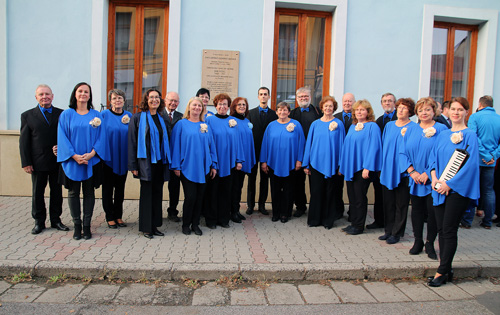
Zvolenský spevácky zbor (2018)
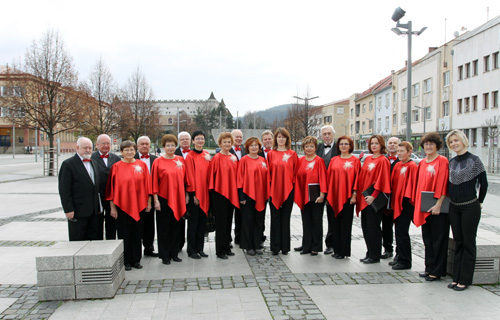
Zvolenský spevácky zbor (2014)
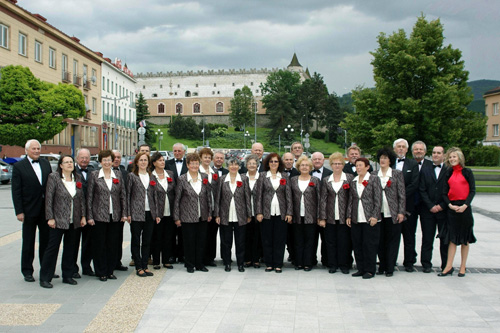
Zvolenský spevácky zbor (2013)